
Stocking the shelves before the storm: Cumberland’s plan for a food-secure future
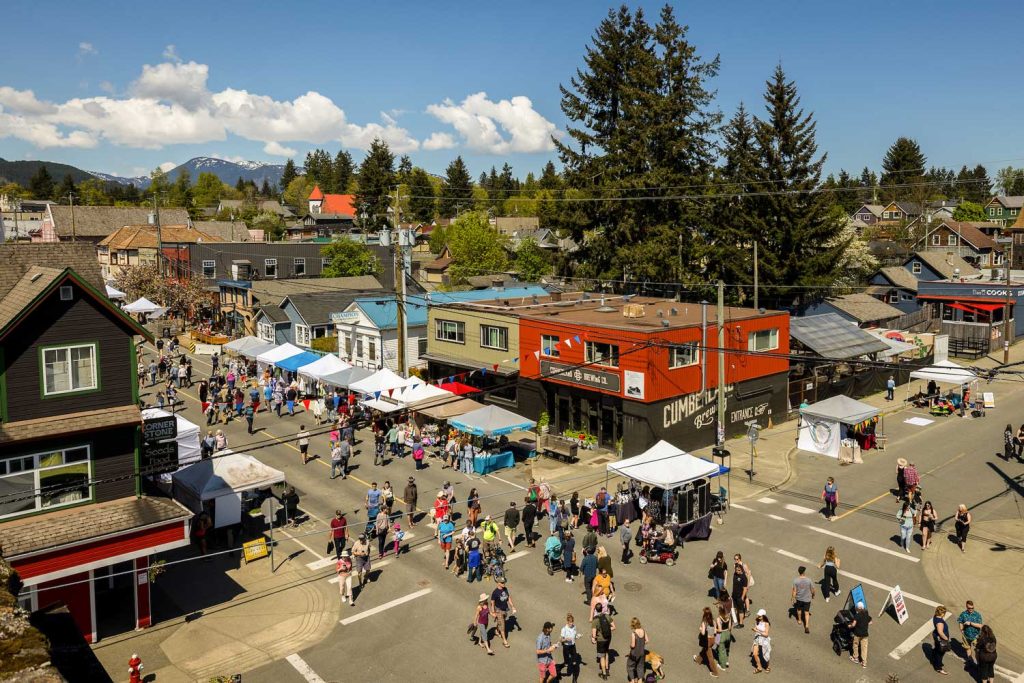
Picture a winter storm that closes the highway, or a wildfire that severs the routes onto Vancouver Island. Within days, grocery shelves thin out. For a community at the end of a long and fragile supply chain, the question is not whether food access will be tested by a climate-driven emergency, but when — and whether anyone has planned for it.
The Village of Cumberland decided not to wait for the answer.
With a $15,000 Healthy Public Policy grant from PlanH, the small Vancouver Island municipality set out to weave food security into the heart of its emergency planning — a connection that, the project team quickly discovered, almost no local government in Canada had formally made.
“From a practical perspective, food access and food systems are extremely important in an emergency situation,” the project team wrote in their final report. “The fact that emergency management and other systems have been built that don’t consider food system resiliency in emergencies shows a larger gap.”
The work was led by Maurita Prato and Naomi Robert, co-chairs of the Comox Valley Food Policy Council, who brought deep roots in the region’s food systems and local government landscape. Their original goal was modest: develop two policies — one for local food procurement, one for emergency planning — that Cumberland could fold into its Official Community Plan.
They ended up with four.
The team built what they call “policy tools” — practical, regionally appropriate packages a council can actually act on. The first, pre-established emergency procurement arrangements, would let the Village line up trusted food vendors before a crisis so agreements can be activated the moment they are needed. The second, neighbourhood emergency preparedness programs, leans on something less tangible: the block parties, placemaking and everyday neighbourliness that mean people know who on their street might need help when the power goes out. The third turns local food procurement into routine practice, strengthening the local food economy in calm times so it is sturdier in hard ones. The fourth connects ecosystem stewardship and Indigenous food sovereignty, recognizing that resilient food systems are inseparable from healthy land and from the traditional food practices that have sustained communities here for generations.
To ground each tool in real experience, Prato and Robert went looking for precedent — and this is where the project became something larger than Cumberland. They interviewed more than two dozen local governments and organizations across BC and Canada, from Hornby and Quadra Islands to Saanich, Victoria, Courtenay, Squamish and the City of Toronto, gathering stories of what has worked elsewhere.
What struck them most was how often they hit a wall — precedents with practice but no policy, policy with no practice, or simply dead ends. Rather than a setback, the team read this as a signal. “The fact that we kept bumping up against limits with local government policy and practice means we are actually onto something,” Prato noted. Building food systems into emergency planning, it turns out, is close to uncharted territory — and a space where new work is badly needed.
That realization reshaped the project’s ambition. Cumberland is already regarded as a municipal leader in food policy, with progressive work in urban agriculture and social procurement. So the team decided the road map they were building should not stay in one village. Alongside the Cumberland-specific report, they are preparing a transferable version any BC municipality or regional district can pick up.
A recurring theme in their interviews points to what makes that road map work: relationships. Comox Valley Emergency Management staff told the team that the connections built across “silos” and sectors before an emergency are what take pressure off scarce resources when one hits. Emergency preparedness, it turns out, is as much about knowing your neighbours as stockpiling supplies.
The project also carried a deliberate equity lens, drawing on a Comox Valley community workshop — itself supported by PlanH — that asked four plain questions of any new policy: Who will benefit? Who will be excluded? What creates that exclusion? What promotes inclusion? Each of Cumberland’s four policy tools was built with the community’s most vulnerable residents in mind.
The team’s final report, “Building Capacity for Food Systems within Emergency Planning,” was presented to Cumberland’s Mayor and Council through a formal delegation on October 27, 2025. For Prato and Robert, that presentation is a beginning, not an ending.
“Our big success is the report we have created,” they wrote. “We hope this is the first step to implementation of some policies and practices across Cumberland, the CVRD and more widely.”
Their closing remarks frame the stakes plainly. “In this changing climate, we know that historical trends will not be good indicators of future trends, and there is a growing need to strengthen the resilience of our communities through thoughtful policy development as well as through community connections.”
For a village at the end of the supply line, that work has already begun.
The report can be accessed here.